
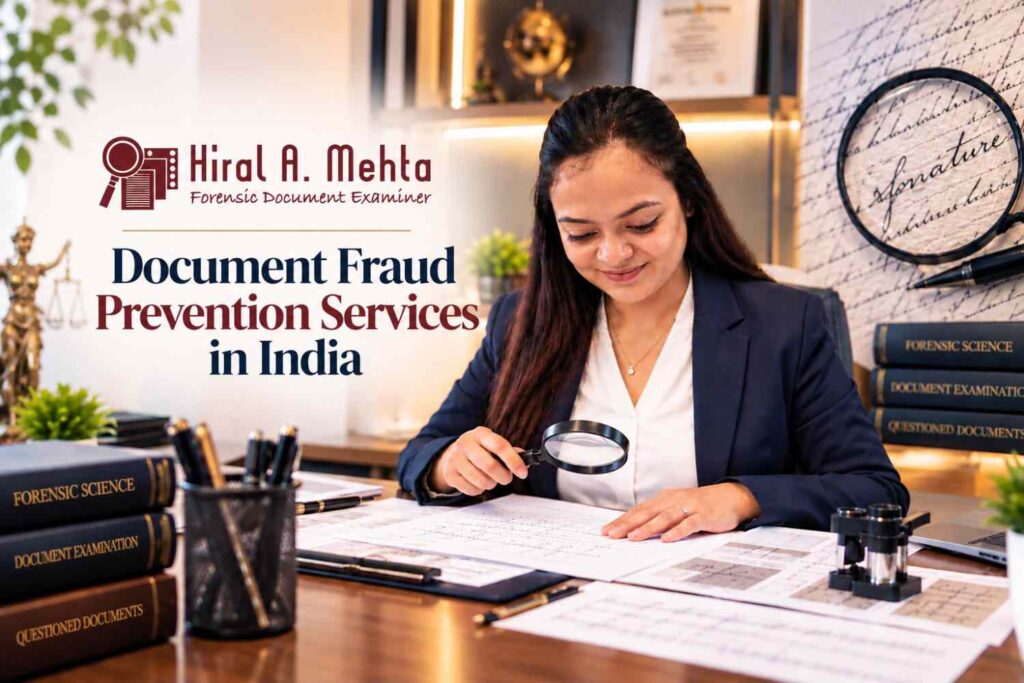
Document Fraud Prevention Services in India
Documents are essential in legal transactions, banking, property dealings and business agreements. Before relying on an important document, it is useful to assess concerns about its authenticity, signatures, handwriting or possible alterations.
Hiral A. Mehta provides forensic document examination and consultancy for questioned documents and document-related concerns. Document Fraud Prevention Services India may help individuals and organisations assess document-related risks before making important decisions.
The appropriate assessment depends on the type of document, the transaction involved and the specific concerns raised. Forensic examination can help evaluate relevant document features, but it cannot guarantee that every form of fraud will be identified or prevented.
What Are Document Fraud Prevention Services?
Document fraud prevention involves assessing document-related concerns and identifying issues that may require further verification before a document is relied upon.
Depending on the case and the services available, this may involve examining questioned signatures, handwriting, visible alterations or other relevant document features. The purpose is to help the requesting party understand potential concerns and determine whether further checks are necessary.
Document-related risks may arise in:
- Property transactions and agreements
- Banking and financial documentation
- Business contracts and commercial records
- Wills, affidavits and declarations
- Documents containing disputed signatures
- Records with suspected overwriting, additions or alterations
Document examination is one part of a broader due-diligence process. Identity checks, ownership verification, institutional records and other transaction-specific checks may also be necessary.
Document Verification Before Legal Transactions
Document Verification Before Legal Transactions can be an important step when documents are being considered for property purchases, contracts, financial arrangements or other legal matters.
Before relying on a document, the parties involved may need to consider whether its contents, signatures and physical features raise concerns that require further investigation.
A forensic document examination may be relevant when:
- A signature appears inconsistent with known samples.
- A handwritten entry or figure is disputed.
- A document appears to contain overwriting or additional entries.
- The authenticity of a written agreement is questioned.
- There are concerns about the integrity of an important record.
The appropriate checks depend on the transaction. A forensic examiner may assess specific document features, while legal professionals, banks, registries or other authorised organisations may need to verify ownership, identity, registration or other records.
Forensic Document Verification Expert
A Best Forensic Document Verification Expert examines relevant document features to assess specific concerns relating to authenticity, handwriting, signatures or suspected alterations.
Depending on the case, an examination may involve:
- Comparing questioned signatures with suitable reference samples
- Assessing disputed handwriting
- Examining suspected overwriting or additions
- Reviewing visible features that may be relevant to document integrity
- Identifying limitations in the available material
The examination is based on the documents and samples provided. An expert can explain the findings and limitations, but cannot independently confirm every aspect of a transaction or guarantee that a document is free from fraud.
Where a document is intended for a legal or financial transaction, the examination should be considered alongside appropriate legal and institutional verification.
Document Authenticity Verification in India
Document Authenticity Verification India may be relevant when an individual, business or professional needs to assess concerns about a document before relying on it.
The nature of the assessment depends on the type of document and the question being investigated. For example, a disputed signature may require comparison with known signatures, while a document with suspected alterations may need a different examination approach.
Documents that may raise authenticity concerns include:
- Agreements and contracts
- Cheques and financial records
- Property-related documents
- Wills and affidavits
- Handwritten statements and letters
- Other records containing questioned signatures or entries
Original documents are often preferable for detailed forensic examination because photocopies and scans can limit the assessment of certain features.
Document authenticity assessment does not replace checks with the issuing authority, registration office, bank or other relevant institution. A complete verification process may require several independent checks.
Fraud Prevention Consultancy for Banks
Fraud Prevention Consultancy for Banks involves considering document-related risks that may arise during financial documentation and verification processes.
Questioned signatures, altered entries and inconsistencies in submitted documents may require further review. Where appropriate, forensic document examination may help assess specific concerns involving handwriting, signatures or suspected document alterations.
Potential areas of concern include:
- Questioned signatures on financial documents
- Suspected alterations to written entries or figures
- Documents requiring additional authenticity assessment
- Records where the original and submitted copies appear inconsistent
- Cases requiring an independent forensic opinion
The scope of any consultancy depends on the institution’s requirements and the examiner’s actual service offering. Banks must continue to follow their own compliance, identity verification, transaction monitoring and fraud-prevention procedures.
Forensic document examination may support a broader review, but it does not replace a bank’s internal controls or guarantee the prevention of financial fraud.
Document Fraud Risk Assessment
A Document Fraud Risk Assessment helps identify document-related concerns that may need further investigation before a document is relied upon.
The assessment begins with understanding the document’s purpose, the concern raised and the evidence available. Relevant questions may include whether a signature is disputed, whether entries appear altered or whether an original document is available for examination.
A document-related risk assessment may consider:
1. Document Review
Understand the type of document, its intended use and the specific concern requiring assessment.
2. Identification of Potential Issues
Identify questioned signatures, handwriting, visible alterations or other features that may warrant further examination.
3. Review of Supporting Material
Consider available originals, reference signatures, earlier document versions and other relevant records.
4. Assessment of Limitations
Determine whether the material is suitable for the proposed examination or whether additional evidence is needed.
5. Recommendations for Further Checks
Where appropriate, identify additional document examination or independent verification steps that may be necessary.
The assessment should distinguish between an observed irregularity and confirmed fraud. The presence of a concern does not, by itself, prove wrongdoing.
Documents and Information Required
For an initial review, you may be asked to provide:
- A copy or scan of the document in question
- Details about the transaction or concern
- Information about any disputed signature or suspected alteration
- Relevant reference signatures or earlier document versions, where available
- The original document, if required for detailed examination
Preserve original documents carefully. Avoid writing on them, erasing marks or attempting to modify the questioned area. If the matter relates to a legal transaction or ongoing dispute, consult the relevant legal professional about appropriate preservation and verification procedures.
Who May Need Document Fraud Prevention Services?
These services may be relevant to:
- Individuals preparing for important legal transactions
- Businesses reviewing agreements and commercial records
- Legal professionals handling document-related concerns
- Financial institutions assessing questioned documents
- Parties involved in property or inheritance matters
- Organisations seeking a forensic assessment of specific document concerns
The appropriate service depends on the document, the risk being assessed and the scope of the examiner’s work.
Consult Hiral Mehta for Document Fraud Prevention
Assessing document-related concerns before relying on important records may help parties identify issues that require further investigation.
Hiral A. Mehta provides forensic document examination and consultancy for questioned documents and related concerns. If you need assistance with a disputed signature, suspected alteration or another document authenticity issue, the appropriate examination requirements can be discussed after an initial review.
Contact Hiral Mehta to discuss your document verification concerns and determine the appropriate next steps.
FAQs for the Service Page
Document fraud prevention services may involve assessing document-related concerns, examining questioned signatures or handwriting, and identifying suspected alterations that require further investigation.
Document verification may help identify concerns before a document is relied upon. Depending on the transaction, checks may include forensic examination, identity verification, ownership checks and confirmation with relevant authorities.
Depending on the case, an examiner may assess questioned signatures, handwriting, suspected overwriting, additions and other relevant document features.
No. An examination can assess specific features of the material provided, but it cannot guarantee that a document is entirely genuine or that every type of fraud will be detected.
Forensic examination may assist with specific concerns involving questioned signatures, handwriting or suspected document alterations. It should complement, rather than replace, the bank's internal verification and compliance procedures.
It is an assessment of document-related concerns to identify issues that may require further examination or independent verification. Its scope depends on the document and the available evidence.
An original is often preferable for detailed forensic examination because copies may limit the assessment of some features. Requirements depend on the specific concern and the material available.
Consider seeking an appropriate assessment when a document's signature, handwriting, contents or integrity is questioned, particularly before relying on it in an important transaction. The required checks will depend on the circumstances.